Aspire Zone, Al Rayyan · Qatar's national stadium
Khalifa International Stadium
The veteran of Qatar's World Cup venues. Opened in 1976, rebuilt beneath two great arches and reopened in 2017, it is still the place where national-team football and international athletics share a stage.
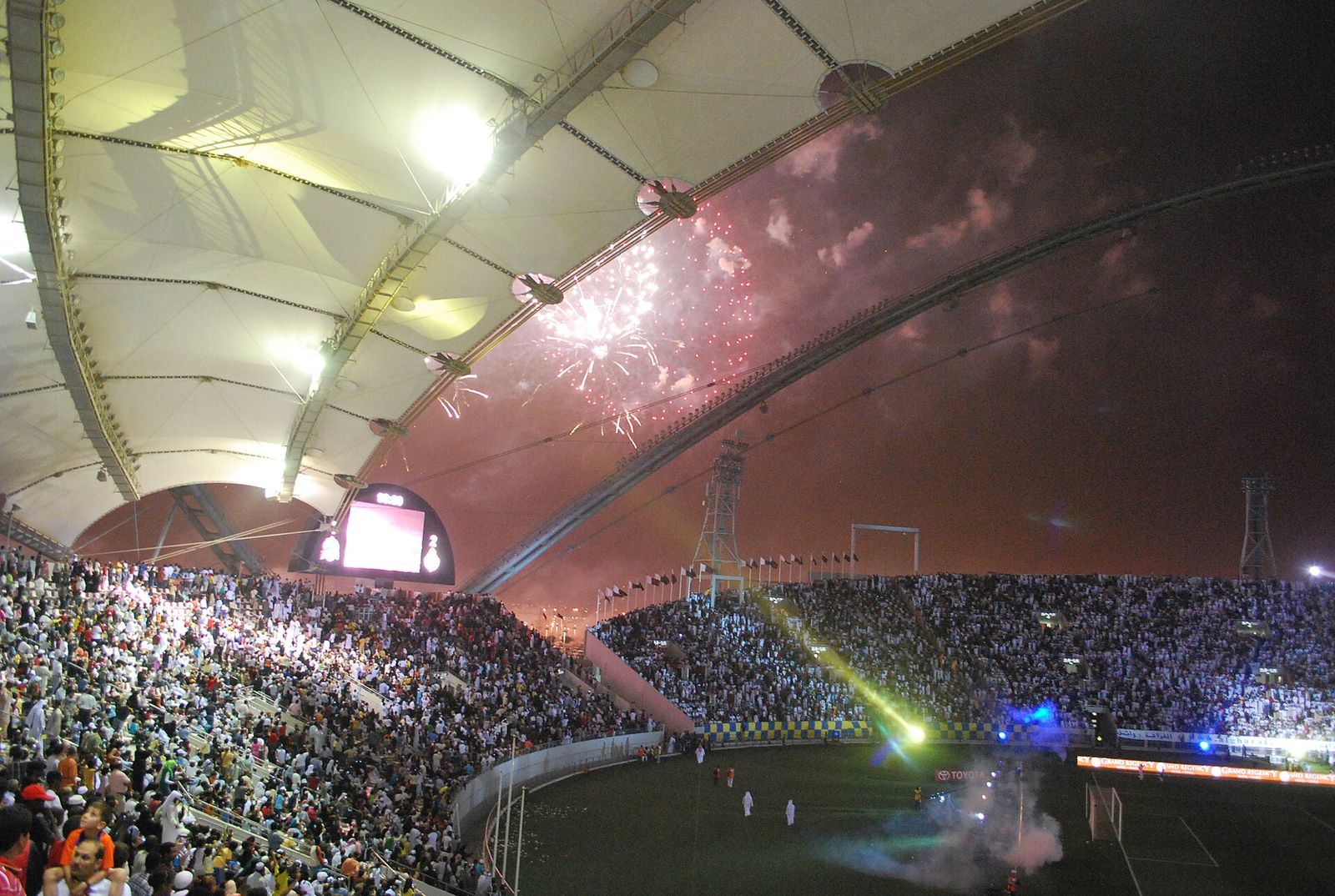
The stadium at the 2009 Amir Cup final, eight years before the rebuild that gave it its present roof.
Spec sheet
Figures for the 2022 tournament layout- Area / city
- Aspire Zone, Al RayyanAbout 9 km west of central Doha
- Opened
- 1976Remodelled in 2005, rebuilt and reopened in May 2017
- Tournament capacity
- c. 45,500Sources give about 45,400 to 45,900
- Design concept
- Twin arches and a new roof2017 redevelopment by Dar Al-Handasah
- Nearest metro
- Gold Sport CityThen a walk through Aspire Zone
- About the design
- The only one of the eight with a running track. The 2017 rebuild added an upper tier on the east side and a roof over every stand, framed by two great arches over the east and west sides.
The stadium in brief
Khalifa International Stadium is the old hand among Qatar's eight World Cup venues. It opened in 1976 for the fourth Arabian Gulf Cup and takes its name from Sheikh Khalifa bin Hamad Al Thani, the Emir at the time. It has been remodelled twice since: first for the 2006 Asian Games, then far more thoroughly for the 2022 World Cup. When it reopened in May 2017 with the Amir Cup final, it was the first of the tournament's stadiums to be finished, five and a half years before the opening match.
It is also the most versatile of the eight: a running track still circles the pitch. Owned by the Qatar Football Association, it remains the traditional home of the national team, and most residents simply call it Khalifa.
Where it is
The stadium stands in Aspire Zone, the sports city in Al Rayyan about 9 km west of central Doha. Aspire Zone grew up around it in the 2000s and now fits training pitches, the Aspire Dome, the Hamad Aquatic Centre and Aspire Park into a single walkable campus. The torch-shaped Aspire Tower, built for the 2006 Asian Games, rises close by and makes an easy landmark.
Education City lies a short drive to the north, so it is easy to pair Khalifa with Education City Stadium in one day out west.
Design and architecture
The 1976 stadium was a classic open oval wrapped around an athletics track. The 2005 makeover rebuilt the western stand with a second tier and a roof, roughly doubled the capacity to around 40,000 and added a huge lighting arch on the east side, used for fireworks at the 2006 Asian Games opening ceremony.
The redevelopment that ran from 2014 to 2017, designed by Dar Al-Handasah, went much further. A new upper tier went up on the east side and a roof now covers every stand, framed by two great arches that have become the stadium's signature.
Inside the bowl
Because of the track, the lower rows sit further from the touchline than at the football-only stadiums, so the views are broad rather than steep. For football, seats along the sides in the middle tiers usually give the best balance of distance and angle.
Cooling and sustainability
Khalifa was the proving ground for the stadium cooling that made a Qatari World Cup possible. Chilled air is fed through outlets beneath the seats and vents around the pitch, an approach developed with engineers at Qatar University and later rolled out across the other venues.
When it reopened in 2017, Khalifa became the first stadium to receive a four-star rating under GSAS, the Global Sustainability Assessment System used across the Middle East and North Africa. At the 2019 World Athletics Championships the track events ran inside the cooled stadium, while the marathon started around midnight on the Corniche to avoid the heat.
History and big matches
Few stadiums in the Gulf have seen as many finals. All 22 matches of the 1976 Arabian Gulf Cup were played here, and in 1992 Qatar won its first Gulf Cup title at the same ground. Japan beat Australia 1–0 in the 2011 Asian Cup final, and in December 2019 Liverpool beat Flamengo 1–0 after extra time in the Club World Cup final.
The 2022 World Cup brought eight matches, beginning with England's 6–2 win over Iran, which set the stadium's attendance record. Japan came from behind to beat Germany 2–1 here, and on 17 December Croatia beat Morocco 2–1 in the third-place play-off.
Since then Khalifa has staged six matches of the 2023 Asian Cup (played in early 2024), the 2025 U-17 World Cup final, won 1–0 by Portugal against Austria, and a semi-final of the 2025 Arab Cup.
After 2022
Several of the newer venues were planned to lose seats once the tournament was over. Khalifa simply went back to being the national stadium, with national-team fixtures, cup finals and athletics on its calendar. Published capacity figures range from about 45,400 to 45,900, so check the venue's own information for a specific event.
The redevelopment also produced the 3-2-1 Qatar Olympic and Sports Museum, opened beside the stadium in 2022. Looking ahead, Khalifa is expected to host track and field when the Asian Games return to Doha in 2030.
Getting there
The metro is the simplest way in. Sport City station on the Gold Line serves Aspire Zone and lies a handful of stops west of Msheireb, the central interchange where the Red, Green and Gold lines meet. Our Getting Around guide explains how the metro works.
How to get there
-
Take the Gold line to Sport City
From Msheireb, ride west towards Al Aziziyah and get off at Sport City, the stop before the end of the line.
-
Walk through Aspire Zone to your gate
Follow the signs from the station. Depending on your gate, allow roughly 10 to 20 minutes on foot, and longer when crowds are heavy.
-
Or arrive by Road
Taxis and ride-hailing apps can bring you close, but event-day drop-off points may be some way from the gates.
Event-day arrangements change. Check the metro operator's and the venue's current information before you travel.
Around the stadium
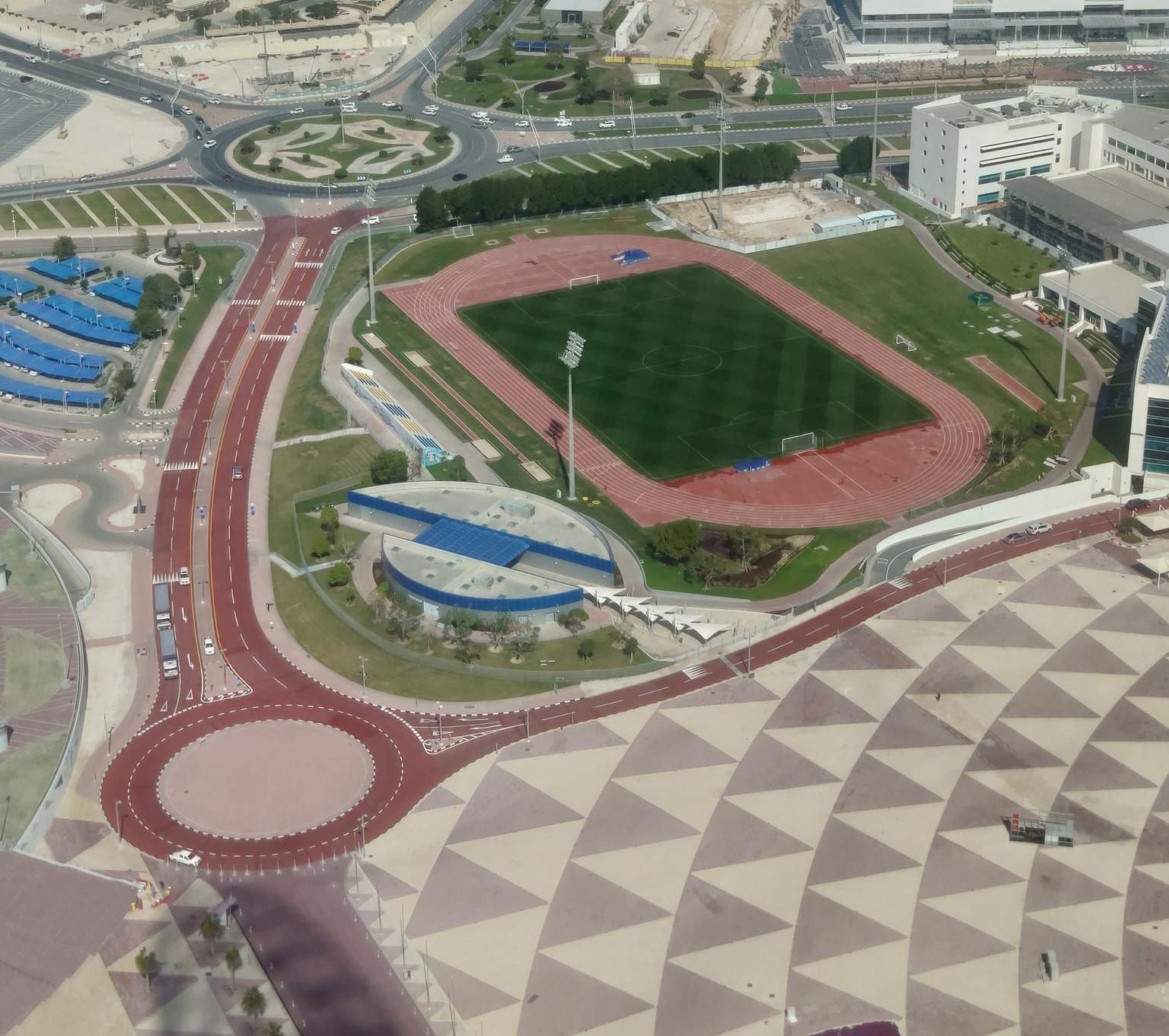
3-2-1 Qatar Olympic and Sports Museum
The museum beside the stadium covers the history of sport, the Olympic movement and Qatar's own sporting story, with interactive displays that suit families. Opening hours and entry rules change, so check the museum's official information before you visit.
Aspire Park
Lawns, a lake and shaded paths fill with walkers and joggers as the evening cools, and the park is a pleasant place to wait while post-match crowds thin out.
Aspire Dome and the Hamad Aquatic Centre
The Dome staged the 2010 World Indoor Athletics Championships, and both venues were used for the 2024 World Aquatics Championships. See our More Venues page, and Sights for the rest of the city.
Visiting tips
Average daily highs in Doha are around 36 °C in October and only drop to the mid-20s between December and February, so the walk from the metro can be tiring outside winter. For big fixtures, aim to reach Sport City 90 minutes to two hours before kick-off; league matches are far calmer.
What to carry
- A refillable water bottle, if the venue's rules allow it
- A hat and sunscreen for the walk through Aspire Zone
- A light layer, because the cooled stands can feel chilly after dark
- A charged phone with your digital ticket and the metro route saved
- The smallest bag you can manage, since bag rules can be strict
Check before you go
Opening hours, entry rules and timetables change, so check the official venue or operator information before you visit. Our Matchday Guide covers security, heat and getting home in more detail.
Frequently asked questions
Which metro station is closest to Khalifa International Stadium?
Sport City on the Gold Line, followed by a walk through Aspire Zone. On big event days, allow extra time.
Why is there a running track around the pitch?
Khalifa was built as a multi-sport national stadium and kept its track through both redevelopments. It hosted athletics at the 2006 Asian Games and the 2019 World Athletics Championships, and it is expected to do so again at the 2030 Asian Games.
Can I see the stadium when there is no event?
Aspire Park is a public space, and the museum next door is the easiest way to get close on a non-event day. Access to the stadium itself depends on the operator's arrangements at the time, so check official information before you go.